Football apparel sizing is frustratingly inconsistent between brands — a medium in Nike fits differently from a medium in Adidas, which fits differently again from Puma and Under Armour. This cross-brand inconsistency creates confusion for individual purchasers and logistical challenges for clubs ordering squad apparel, where predictable sizing is essential for minimizing returns and ensuring all team members receive correctly fitting garments. Understanding how each major brand approaches sizing, where the specific differences lie, and how to navigate these differences efficiently is essential knowledge for any footballer or team equipment manager responsible for apparel purchasing decisions.
This guide provides a comprehensive comparison of sizing approaches across Nike, Adidas, Puma, and Under Armour football apparel, practical measurement guidance that applies regardless of brand, and specific strategies for both individual purchasing and team ordering that reduce sizing errors and improve fit satisfaction across the range of body types that football squads typically encompass.
How to Measure Correctly
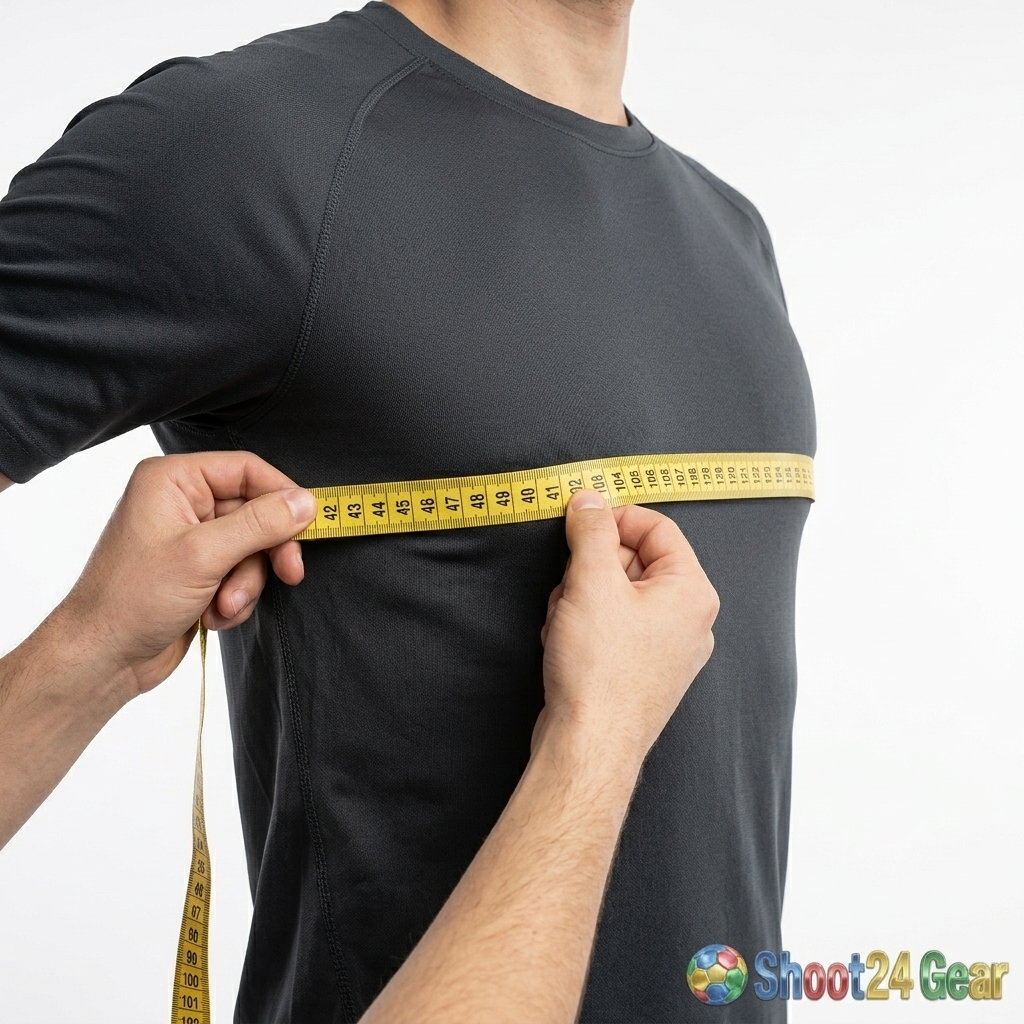
Accurate body measurements are the foundation of successful apparel sizing regardless of brand. Taking measurements correctly eliminates the guesswork that causes sizing errors when relying on general size labels alone.
Chest measurement: Measure around the fullest part of the chest, passing the measuring tape under the arms and across the shoulder blades at the back. Keep the tape parallel to the floor and snug against the body without compressing the chest. This measurement determines training top, jacket, and jersey sizing across all brands.
Waist measurement: Measure around the natural waist — the narrowest point of the torso, typically about two centimeters above the navel. Keep the tape snug but not tight, and maintain natural posture without sucking in the stomach. This measurement determines shorts and training pants sizing.
Hip measurement: Measure around the widest point of the hips, typically about twenty centimeters below the natural waist. This measurement is particularly important for women’s apparel sizing but also affects men’s shorts and pants fit. Keep the tape parallel to the floor and measure without clothing compression.
Inseam measurement: Measure from the crotch seam to the desired hem position along the inside of the leg. This measurement determines training pants length. For footballers, the ideal inseam creates a hem that sits at the ankle bone when standing — long enough to cover the shin when the ankle is flexed but not so long that the hem pools over the football boot.
Nike Sizing
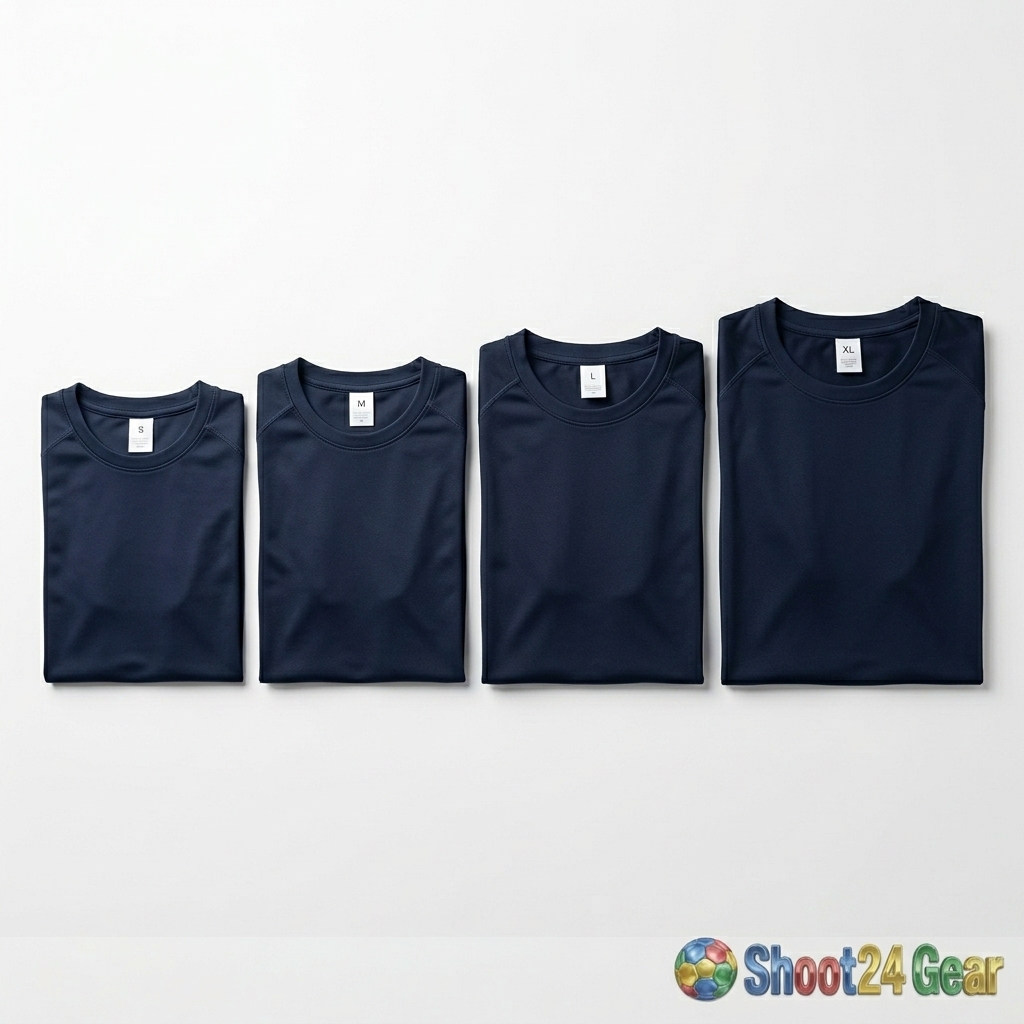
Nike football apparel uses what the industry describes as a “slim athletic” fit profile. Nike’s sizing runs slightly smaller and more fitted than most competitors at the same labeled size, creating a closer-to-the-body silhouette that appeals to footballers who prefer a streamlined, modern appearance.
Fit characteristics: Nike training tops sit closer to the body through the torso than Adidas or Puma equivalents at the same size. Sleeve length tends slightly shorter, and the overall garment length is marginally more cropped than competitors. This slimmer approach creates a clean, athletic appearance but provides less natural layering room than roomier brands.
Layering consideration: If you plan to wear compression base layers beneath Nike training tops, consider sizing up by one size to accommodate the base layer without excessive tightness. The slim base fit leaves less accommodation for layering than brands with roomier sizing profiles.
Nike Pro compression: Nike Pro compression products are designed to fit skin-tight as a second skin. Size Nike Pro compression according to your actual body measurements without allowance for layering beneath — compression products are intended as the innermost layer against the skin.
Adidas Sizing
Adidas football apparel uses a “standard athletic” fit profile — neither as slim as Nike nor as relaxed as some competitors. This moderate positioning makes Adidas sizing the most predictable for footballers transitioning from general clothing sizes to football-specific apparel.
Fit characteristics: Adidas Tiro and Tiro Competition products provide comfortable room through the torso and arms without excessive looseness. The fit accommodates a base layer beneath without requiring size adjustment for most body types. Sleeve length and garment length are moderate — longer than Nike but shorter than some budget brands.
Consistency across ranges: Adidas maintains reliable size consistency between their Tiro Training, Tiro Competition, and Tiro Elite tiers. A medium in Tiro Training fits the same body as a medium in Tiro Competition, simplifying purchasing when upgrading between tiers or mixing products from different tiers within a team order.
Puma Sizing
Puma football apparel uses a “relaxed athletic” fit profile — slightly roomier than both Nike and Adidas at equivalent labeled sizes. This roomier approach suits footballers who prefer less body-conscious fit or who require natural layering accommodation without sizing up.
Fit characteristics: Puma teamGOAL and teamFINAL products provide generous room through the torso and arms compared to Nike equivalents. The roomier fit naturally accommodates cold weather base layers without requiring size adjustment. Sleeve length and garment length tend slightly longer than Nike and comparable to Adidas.
Transition from Nike: Footballers switching from Nike to Puma may find their usual Nike size feels slightly loose in Puma products. If you prefer a body-conscious fit similar to Nike’s approach, consider selecting one size smaller in Puma than your Nike size. If you prefer a comfortable, relaxed fit, your standard size in Puma will provide that naturally.
Under Armour Sizing
Under Armour uses a named fit system that varies significantly within the brand, making their sizing approach unique among the major football apparel brands.
Compression fit: Under Armour compression is tighter than Nike Pro and Adidas Techfit at equivalent sizes. Footballers accustomed to Nike Pro compression may find Under Armour compression noticeably tighter. Size according to Under Armour’s compression-specific size charts rather than assuming cross-brand compression size equivalence.
Fitted: Under Armour’s “Fitted” category provides a close-to-the-body fit without compression — comparable to Nike’s standard training fit. This is the most cross-brand predictable Under Armour fit category for footballers transitioning from other brands.
Loose: Under Armour “Loose” products provide the most relaxed fit in their range, comparable to Puma’s roomier approach. Select Loose fit for outer layers, hoodies, and casual wear where comfort takes priority over streamlined appearance.
Cross-Brand Size Comparison
The following general relationships apply for men’s football apparel sizing across brands, though individual products may vary:
Nike Medium ≈ Adidas Medium (slightly roomier) ≈ Puma Small-Medium ≈ Under Armour Medium (Fitted)
A footballer who wears a Nike Medium will typically find an Adidas Medium slightly roomier, a Puma Medium noticeably roomier, and an Under Armour Medium in Fitted category comparable. These relationships are approximate — always consult brand-specific size charts using your actual body measurements for the most accurate size selection.
Team Ordering Strategies
Team apparel ordering introduces sizing challenges that individual purchasing does not face — specifically, the challenge of accurately sizing an entire squad of diverse body types from a single brand’s size chart without the opportunity for individual try-on before ordering.
Measurement-based ordering: Collect actual chest, waist, hip, and inseam measurements from every squad member rather than asking players to declare their general clothing size. Convert these measurements to the specific brand’s sizes using the brand’s official size chart. This measurement-based approach reduces sizing errors by fifty percent or more compared to self-declared size ordering.
Size sample ordering: Before committing to a full squad order, request or purchase sample garments in a range of sizes for squad members to try. This try-on approach identifies sizing issues — particularly for players between sizes or with unusual proportions — before the full order is placed. The small investment in sample garments prevents the significantly larger cost of returns and exchanges on a full squad order.
Buffer stock: Order additional garments in the most common squad sizes (typically Medium and Large) as buffer stock for mid-season replacements, new squad members, and sizing corrections. Having buffer stock available eliminates the delays and minimum order complications of mid-season reorders for individual garments.
Common Sizing Mistakes
Assuming cross-brand size equivalence: The most common sizing mistake in football apparel is assuming that your size in one brand applies to all brands. A Nike Large and a Puma Large are not the same garment dimensions. Always consult the specific brand’s size chart when purchasing from a brand you have not previously worn.
Sizing training tops without considering base layers: Trying training tops in isolation — without wearing the base layer you intend to wear beneath — leads to selecting sizes that feel comfortable alone but become restrictive when layered. Always test training top fit while wearing your intended base layer configuration.
Buying oversized for growth (youth): Parents purchasing youth football apparel often buy one or two sizes larger to extend the garment’s usable lifespan as the child grows. While understandable from a budget perspective, oversized training apparel restricts movement, affects confidence, and looks unprofessional. Purchase current-fit apparel and replace as growth requires rather than compromising current performance and appearance for future fit.
Ignoring height in pants sizing: Two footballers with identical waist measurements but different heights require different inseam lengths. Standard training pants sizing assumes average proportional relationships between waist and inseam. Footballers who are significantly taller or shorter than average for their waist size may need to adjust pants sizing accordingly — potentially selecting a larger waist size for length on tall players and hemming, or selecting a shorter inseam option where available.
Online Purchasing Guidance
Online purchasing removes the try-on opportunity that physical retail provides, making accurate sizing particularly important for online football apparel orders.
Measure before ordering: Take fresh body measurements before every significant online order. Body composition changes between seasons, and measurements from six months ago may no longer be accurate. Use current measurements against the brand’s current size chart for the specific product range you are ordering.
Check return policies: Before ordering, verify the retailer’s return and exchange policy for sizing issues. Some retailers offer free returns for sizing exchanges while others charge return shipping that may exceed the cost benefit of online purchasing. Understanding return policies before ordering reduces the financial risk of sizing errors.
Read product-specific reviews: Online reviews from verified purchasers often include sizing feedback — whether a specific product runs large, small, or true to the brand’s size chart. This product-specific feedback provides sizing intelligence beyond the general brand sizing profile, identifying specific products that deviate from the brand’s typical sizing.
Body Type Considerations
Standard sizing assumes average proportional relationships between body measurements. Footballers with non-average proportions face specific sizing challenges that require strategic solutions.
Broad shoulders with slim waist: Select upper body garments (training tops, jackets) based on shoulder and chest measurement rather than waist. The resulting looseness through the waist is less problematic than tightness through the shoulders and chest that restricts arm movement. For footballers with very pronounced shoulder-to-waist ratios, Under Armour’s Fitted category often provides the best accommodation due to their accommodating size profiles.
Tall and slim: Standard sizing may produce training tops and jackets that fit the chest but are too short through the torso and sleeves. Look for “long” or “tall” sizing options where available, or consider sizing up and accepting slightly roomier chest fit in exchange for adequate length. Nike’s slightly cropped proportions are particularly challenging for tall, slim footballers — Adidas or Puma may provide better length-to-width ratios for this body type.
Shorter and muscular: Standard sizing may produce adequate chest fit but excessive length through the torso and sleeves. Puma’s roomier fit accommodates muscular builds through the chest while the generous proportions create less excess length than sizing up in slimmer brands would produce. Consider having sleeves shortened by a tailor if standard lengths consistently extend past the wrist.
Larger body types: Extended size ranges (XXL, 3XL, 4XL) vary significantly between brands. Nike’s extended sizes are limited in some product ranges, while Adidas and Under Armour typically offer more comprehensive extended sizing. For team orders including larger squad members, verify extended size availability in your chosen brand and range before committing to the order.
Seasonal Sizing Adjustments
Apparel requirements change between seasons, and sizing should account for the layering differences that seasonal temperature changes create.
Summer sizing: Warm weather training involves fewer layers — often a single training top over a lightweight base layer or no base layer. Summer apparel can be sized for this minimal layering configuration, selecting the size that fits comfortably with the lightest layering you intend to use.
Winter sizing: Cold weather training involves multiple layers — thermal base layer, training top, and potentially a mid-layer beneath an outer jacket. Outer layers (jackets, rain jackets) should be sized to accommodate this full layering system without restriction. Test winter outer layer sizing while wearing all intended under-layers for accurate fit assessment.
Year-round sizing: If purchasing a single training jacket for year-round use, size it for winter layering accommodation. A jacket that fits winter layers will simply have slightly more room in summer — a minor inconvenience compared to a jacket that fits perfectly in summer but cannot accommodate winter layers when temperatures drop.
Youth Football Sizing
Youth football apparel sizing presents unique challenges due to the rapid growth and diverse physical development rates among young players.
Age-based vs measurement-based sizing: Youth sizing typically uses age ranges (7-8, 9-10, 11-12, etc.) as the primary size indicator. These age ranges assume average growth patterns, which many individual children do not follow. A tall nine-year-old may need the 11-12 age range for length while a shorter eleven-year-old may fit the 9-10 range. Use actual body measurements rather than age for the most accurate youth sizing.
Growth accommodation: While buying significantly oversized for future growth is counterproductive, selecting sizes at the upper end of the appropriate measurement range provides modest growth accommodation without dramatically affecting current fit. This approach typically extends garment usefulness by three to six months compared to selecting sizes at the lower end of the range.
Unisex youth sizing: Youth football apparel below age twelve is often produced in unisex sizing. Above age twelve, where physical development differences between boys and girls become more pronounced, girls should transition to women’s-specific sizing for training apparel that accounts for developing female proportions.
Returns and Exchanges
Despite careful measurement and size chart consultation, sizing errors will occasionally occur. Having a clear returns and exchange strategy minimizes the cost and disruption of incorrect sizing.
Retain packaging: Keep original packaging, tags, and receipts until you have confirmed the fit of new apparel. Most retailers require unworn garments with original tags for returns and exchanges. Removing tags before confirming fit may prevent return or exchange if the size proves incorrect.
Try before training: Try new apparel at home before wearing it to training. Once a garment shows signs of use — grass stains, sweat marks, deodorant residue — most retailers will not accept it for return or exchange regardless of sizing issues. Confirm fit indoors with a full range of movement test before committing the garment to training use.
Team order returns protocol: For team orders, establish a centralized fitting session where all squad members try their garments simultaneously. Collect all incorrect sizes, document the required exchanges, and process the entire exchange as a single transaction. This centralized approach is more efficient than managing individual returns and exchanges from multiple squad members over an extended period.
Summary
Football apparel sizing varies meaningfully between Nike, Adidas, Puma, and Under Armour — what constitutes a “medium” differs across brands in chest width, torso length, sleeve length, and overall fit profile. Nike runs slimmest, Adidas provides moderate athletic fit, Puma offers the roomiest standard sizing, and Under Armour varies by their named fit category system.
Take accurate body measurements and consult brand-specific size charts for every purchase. For team ordering, collect individual measurements from all squad members and use size samples where possible to minimize sizing errors across diverse body types.
Size charts, fit profiles, and product dimensions change between seasons and product generations. Verify current sizing information on official brand websites before making purchasing decisions.