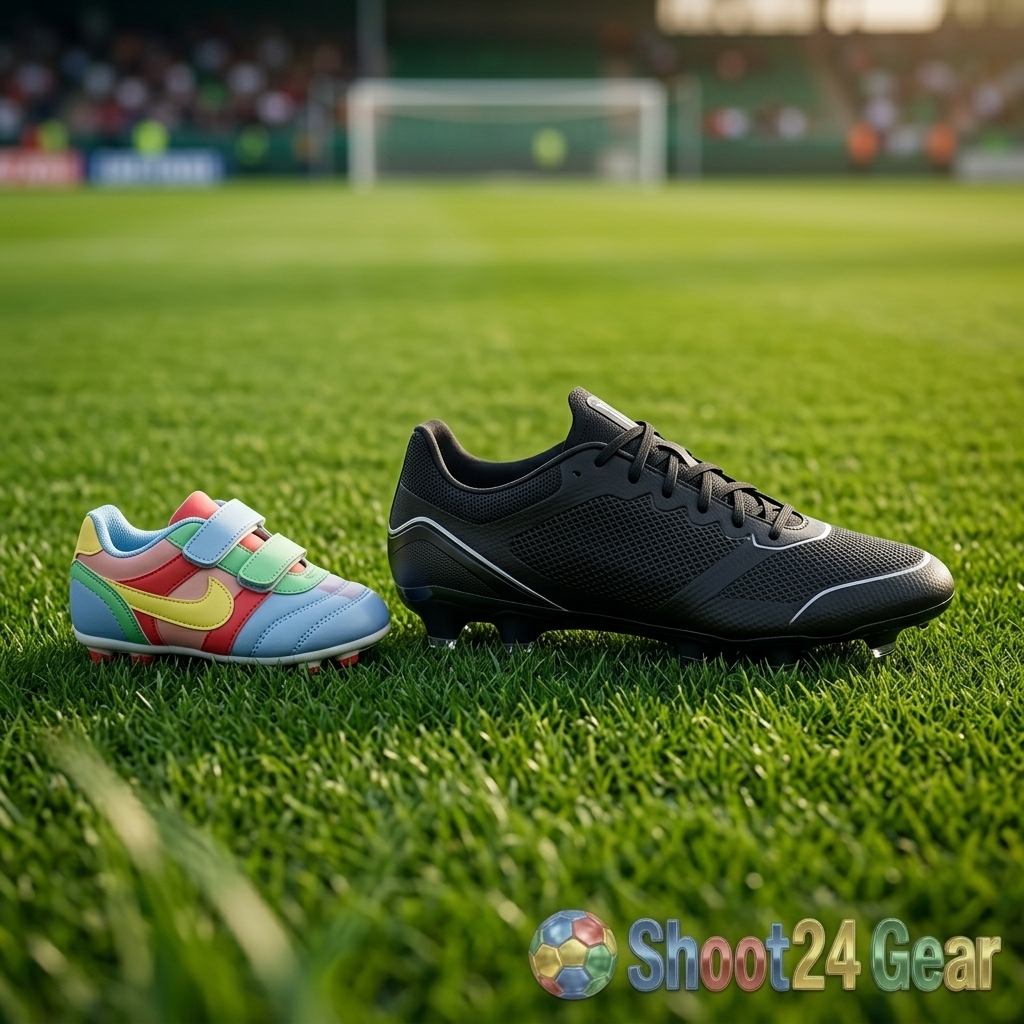
Buying football boots for children and teenagers involves considerations that adult boot selection does not. Growing feet change size multiple times per year. Junior playing surfaces vary from well-maintained academy pitches to rough school fields. Budget constraints matter because boots that fit in September may be too small by February. And the marketing that targets young players — the signature models, the flashy colorways, the promise of playing like their heroes — can override practical considerations that actually determine whether the boot serves the child well.
This guide addresses the practical realities of youth football boot selection: how to size growing feet accurately, when to invest in quality and when to save money, which features matter for developing players, and what mistakes parents and young players commonly make.
Understanding Junior Sizing
Junior football boot sizing follows the same numbering systems as adult boots but starts at smaller dimensions. In the UK system, junior sizes typically run from child size 10 (approximately age 4-5) through junior size 5.5 (approximately age 12-13), after which players transition to adult sizing starting at size 6.
The transition from junior to adult sizing catches many parents off guard. A player who wears junior size 5 does not wear the same shoe as adult size 5 — the last shapes, width profiles, and construction proportions change between junior and adult ranges. When a young player crosses into adult sizing, treat it as a fresh fitting exercise rather than assuming the same size number applies.
Growth rate matters for purchasing timing. Children’s feet grow at varying rates, but on average, a young football player’s feet may grow one to two sizes per year between ages 8 and 14. This rapid growth means a boot purchased in August may be uncomfortably tight by December and unwearable by March. Planning for this growth cycle is essential — both financially and practically.
Measuring Correctly
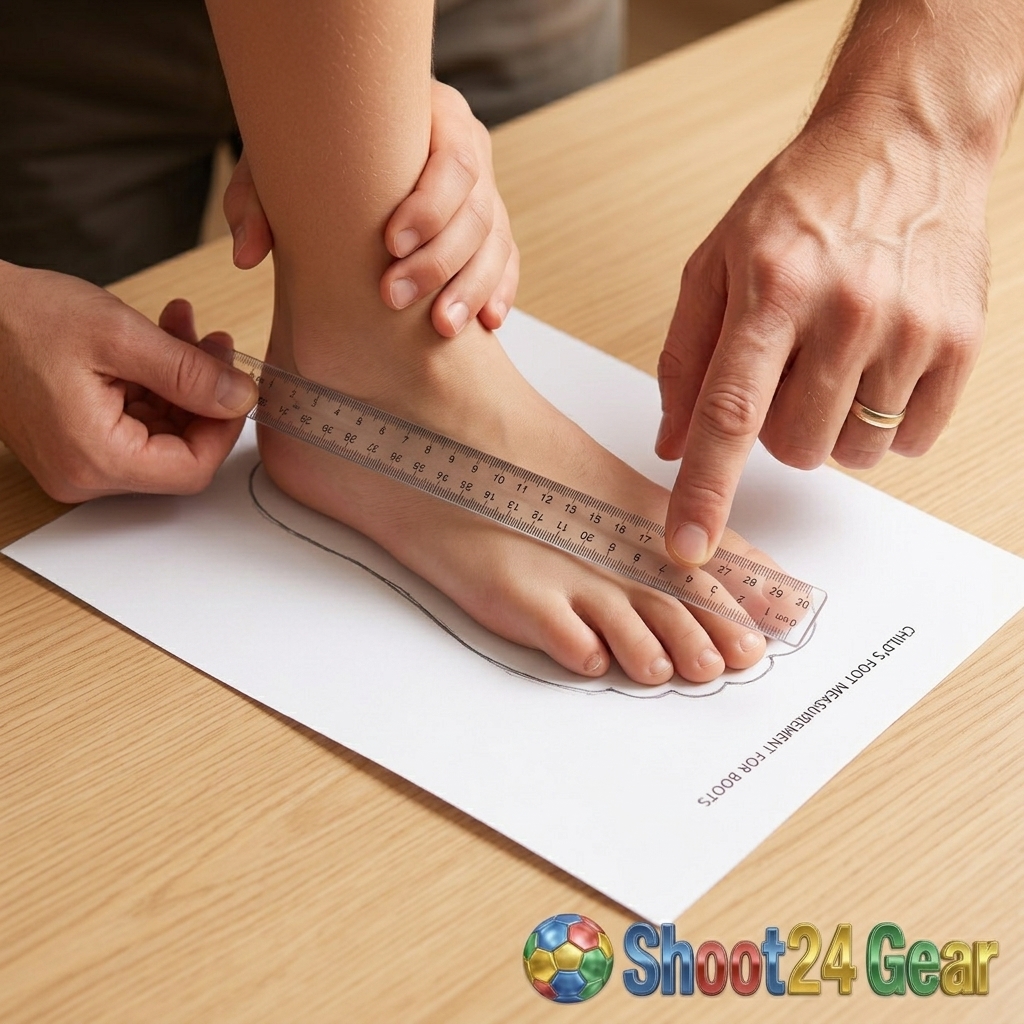
Always measure both feet — children frequently have slightly different-sized feet, and the boot should fit the larger foot. Measure at the end of the day when feet are slightly swollen from daily activity, as this represents the state the feet will be in during active play.
Stand the child on a piece of paper with full weight on both feet. Trace the outline of each foot carefully. Measure the longest dimension (heel to longest toe, which may not be the big toe) and the widest dimension (across the metatarsal heads). Compare these measurements to the brand-specific sizing chart for the boot you are considering.
Allow approximately 10-15mm of space between the longest toe and the front of the boot. This “thumb width” of space accommodates foot movement during play and provides a small growth buffer. Less space risks toe compression; more space creates instability and reduces ball feel.
Growth Buffer vs Proper Fit
The temptation to buy boots “a size too big” so the child can grow into them is understandable financially but problematic practically. Oversized boots cause several problems:
Heel slippage: A boot too long in the heel creates space for the foot to slide during running and direction changes. This sliding causes blisters, reduces stability, and makes the child less confident in their movements.
Reduced ball feel: Excess space at the toe means the ball contacts dead material rather than the foot. The child’s touch suffers because they cannot feel the ball precisely through excess boot material.
Injury risk: Oversized boots increase the risk of tripping, stubbed toes (from the foot sliding forward inside the boot), and ankle instability from inadequate heel lockdown.
The 10-15mm growth buffer mentioned above represents the appropriate compromise — enough space for a few months of growth without compromising current fit quality. When the child’s toes reach the front of the boot with no remaining space, it is time for replacement regardless of how new the boots look.
Age-Appropriate Features
Ages 5-8 (Mini and Youth)
At this age, boots should prioritize ease of use, comfort, and basic protection. Velcro closures or simple lacing systems help young children put on and remove boots independently. Lightweight construction reduces foot fatigue during the short training sessions typical of this age group. Molded studs (FG/AG compatible) suit the varied playing surfaces that young children encounter — school pitches, parks, and basic training grounds.
At this age, boot technology is irrelevant. The child is learning basic ball skills and enjoying playing — they need boots that fit, feel comfortable, and provide adequate grip. Any reputable brand’s entry-level boot meets these needs. Premium elite-tier boots offer no meaningful advantage for a six-year-old learning to kick a ball.
Ages 9-12 (Junior)
As players develop skills and begin competing in organized leagues, boot quality starts to matter more. The ball feel and weight differences between budget and mid-range boots become noticeable as technical skills improve. Mid-range boots from major brands provide the appropriate balance of quality and value at this age — good enough to support developing technique without the premium pricing that rapid growth makes impractical.
Surface-specific boots become more important as junior players begin playing on designated pitches. If the child plays primarily on artificial turf, AG boots provide appropriate traction. If they play on natural grass, FG boots are correct. Many junior leagues play across both surfaces, making AG boots the more versatile choice for players who encounter both.
Ages 13-16 (Youth/Academy)
Teenage players approaching adult size with developing technical abilities can benefit from mid-to-premium tier boots that provide genuine performance characteristics. Foot growth slows relative to younger ages, making boots last longer and justifying slightly higher investment. Players at this stage begin identifying their playing style preferences — speed, control, comfort, leather — and can choose boots that align with their developing strengths.
Academy players at this age may receive boot recommendations or requirements from their clubs. Some academies specify boot types, colors, or brands. Check club requirements before purchasing to avoid buying boots that cannot be worn during organized training and matches.
League and Safety Regulations
Youth football leagues impose footwear regulations that adult competitions do not always share. Understanding these regulations prevents purchasing boots that cannot be used.
Metal studs: Many youth leagues prohibit metal-tipped studs for safety reasons. This means soft ground boots with metal tips may not be usable in junior competitions. Check league rules before purchasing SG boots for young players.
Stud length: Some junior leagues specify maximum stud lengths. Referee pre-match boot inspections are common in organized youth football, and boots that fail inspection may not be worn.
Color requirements: School teams and some youth leagues require specific boot colors — typically all black. This limits selection options and should be verified before purchasing.
Shin guard integration: Most youth leagues require shin guards, which means boot and shin guard compatibility matters. High-top collars can interact with shin guard placement — verify that the boot’s collar does not interfere with the child’s preferred shin guard positioning.
Developing Foot Health
Children’s feet are structurally different from adult feet. The bones are still forming and hardening throughout childhood and into the teenage years. This ongoing development makes proper footwear more important for young players than for adults whose skeletal structure is fully established.
Boots that are too narrow compress the developing metatarsal bones and can contribute to long-term structural problems. Boots that are too stiff restrict natural foot flexion during formative years when muscles and tendons are developing their strength and flexibility patterns. Parents should look for junior boots that allow natural foot movement — flexible soleplates that bend at the toe break, uppers that do not constrain the forefoot, and adequate cushioning for the playing surface.
If a child consistently experiences foot, ankle, or knee pain after playing, a sports podiatrist consultation is advisable. The issue may be boot-related or biomechanical, and professional assessment can identify the cause and recommend appropriate solutions including custom orthotics designed for children’s feet.
Brand Junior Ranges
Nike Junior: The Mercurial, Phantom, and Tiempo lines are available in junior sizes. Academy and Club tiers provide good value for growing feet. Nike junior sizing tends to run narrow.
Adidas Junior: The Predator, Copa, and X lines offer junior sizes. Training and Club tiers represent best value. Adidas junior boots fit slightly wider than Nike equivalents.
Puma Junior: The Future, Ultra, and King lines offer junior versions. Puma’s wider fit profile extends to their junior range, making them suitable for children who find other brands too narrow.
New Balance Junior: Limited but quality junior options. Their heritage of accommodating wider feet makes them worth investigating for children with wider-than-average feet.
Surface Matching for Young Players
Young players often play across multiple surfaces during a typical week. If limited to one pair, AG boots offer the best compromise — they work acceptably on both artificial turf and firm natural grass, covering the two most common youth playing surfaces. For indoor sessions, a second pair of indoor court shoes is necessary.
Budget Considerations
Youth football boot spending should be calibrated to growth rate and playing frequency rather than aspiration or brand preference.
Rapid growth phases (ages 5-12): Boots may last only three to six months before outgrowing. At this replacement rate, mid-range boots (typically 30-50% of elite pricing) provide the best value. Premium boots at this age represent poor return on investment because the child outgrows them before the boots wear out.
Stabilizing growth (ages 13-16): As growth rate slows, boots last longer, and higher investment becomes more practical. Players at this age who train four or five times per week wear boots out through use rather than outgrowing them, making boot quality more relevant to their playing experience.
Dual-pair strategy: For players training frequently, maintaining two pairs — a newer pair for matches and an older pair for training — extends the lifespan of both and reduces per-month cost. Training boots absorb the heavy wear of drills and exercises, while match boots stay fresher for competitive play.
Second-hand boots can be appropriate for the youngest age groups where growth is fastest. Children who outgrow boots before wearing them out leave minimal-wear footwear available through resale platforms, club boot exchanges, and family hand-me-downs. Ensure that any second-hand boots still have adequate stud condition and sole bonding before use.
Common Youth Boot Mistakes
Buying elite-tier boots for young children: A seven-year-old does not benefit from the same boot technology that a professional uses. The money spent on elite boots for young children is better allocated to coaching, training equipment, or simply more frequent replacement with appropriately-priced alternatives.
Ignoring fit complaints: When a child says their boots hurt, listen. Growing feet in too-tight boots develop problems — blisters, blackened toenails, bunion formation, and general discomfort that reduces enjoyment of the game. A child who stops enjoying football because of painful boots is a far greater loss than the cost of replacement footwear.
Choosing based on favorite player: Marketing signature boots toward young players is effective but misleading. The boot a professional player wears is designed for adult feet, elite playing surfaces, and specific performance characteristics that have no relevance to a ten-year-old playing on a school field. Choose boots based on fit and suitability, not based on whose name is on them.
Using outdoor boots indoors: Young players who attend both outdoor training and indoor futsal sessions need appropriate footwear for each surface. Indoor court shoes for indoor play, outdoor boots for outdoor play. Using studded boots on indoor surfaces is unsafe and prohibited by most facilities.
When to Replace
Replace youth football boots when any of the following conditions apply: the child’s toes touch or press against the front of the boot when standing. Visible upper damage exposes the foot or significantly compromises the boot’s structure. Studs are worn flat or unevenly. The soleplate shows separation from the upper. The child consistently complains of foot pain that resolves when wearing other footwear.
Do not wait until boots are visibly destroyed to replace them. A boot that is too small but still looks new is still a boot that needs replacing. The child’s comfort and foot health always take priority over the boot’s visual condition.
Care and Maintenance for Youth Boots
Teaching young players to care for their boots instills habits that serve them throughout their football development. The care routine need not be complex — a few simple steps after each session maintain boot condition and extend usable lifespan.
After every training session or match, remove excess mud using a stiff brush or by tapping the boots together sole-to-sole. Open the laces and remove the insoles to allow air circulation inside the boot. Store boots in a ventilated area — not sealed inside a bag where moisture breeds odor and bacteria.
For wet conditions, stuff boots with newspaper or kitchen towel to absorb internal moisture. Replace the stuffing after a few hours once it has absorbed the moisture. Avoid placing boots on radiators, near heaters, or in direct sunlight — excessive heat damages adhesives and warps synthetic materials. This is the most common care mistake with youth boots, and it causes premature sole separation and upper deformation.
Leather youth boots (available at Academy and Pro tiers in some brands) benefit from occasional leather conditioner application, though this is less critical for junior boots than for premium adult leather boots because junior boots are typically replaced through outgrowing before leather maintenance becomes essential.
Encourage the young player to take responsibility for their own boot care from approximately age 9 or 10 onwards. This teaches equipment responsibility and ensures the player develops a relationship with their equipment that supports long-term development. A player who cares for their boots understands their equipment better and makes more informed choices as they grow into adult boot selection.
The Transition to Adult Boots
The transition from junior to adult football boots typically occurs between ages 12 and 15, depending on the individual’s foot growth rate. This transition involves more than simply moving to larger sizes — adult boots differ from junior boots in several important ways.
Adult soleplates are stiffer and more performance-oriented than junior soleplates. The increased stiffness can feel uncomfortable for younger players whose foot strength has not yet developed to match adult boot resistance. A gradual transition through mid-tier adult boots (Pro or Academy level) with moderate soleplate stiffness helps developing feet adapt without the jarring shift to elite-tier adult stiffness.
Adult boot widths may differ from junior widths within the same brand. A player who found Nike junior boots comfortable may discover that Nike adult boots in the same size feel narrower. Re-measuring feet and re-evaluating brand preferences at the transition point prevents assumptions about fit that may no longer apply.
At the transition point, players who have identified their playing style preferences — speed, control, leather, comfort — can begin selecting adult boots that align with those preferences. This is the natural point to consult the individual boot reviews and comparison guides available on this site to make an informed choice about adult boot selection.
Summary
Youth football boot selection is ultimately about fit, comfort, safety, and value — in that order. The best boot for any young player is the one that fits correctly, feels comfortable during play, meets league safety requirements, and makes financial sense given the child’s growth rate and playing frequency.
Resist the marketing. Focus on the child’s feet. And remember that a properly fitting mid-range boot serves a young player better than a poorly fitting premium one, every single time.
Boot sizing and availability vary between brands. Check official brand sizing guides for the specific model before purchasing, and always measure the child’s feet before ordering.