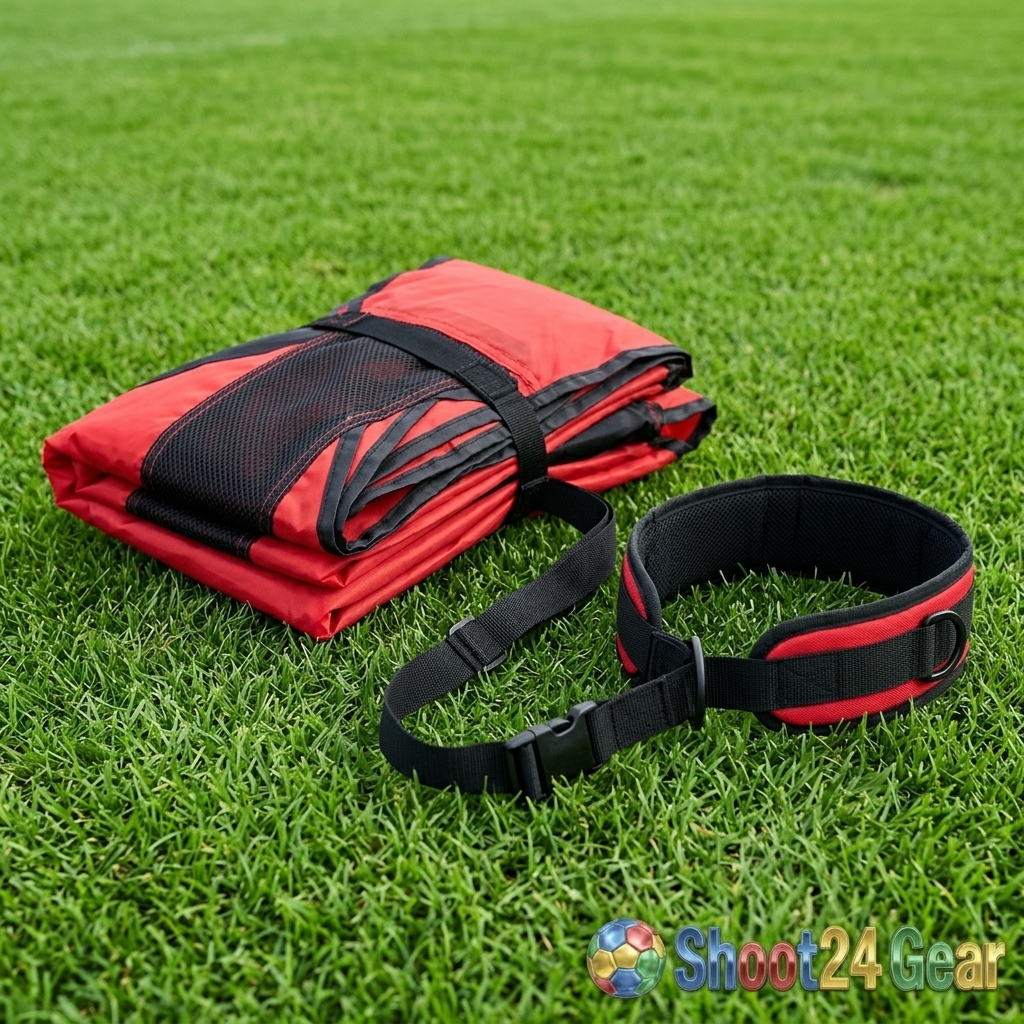
Speed parachutes — also called running parachutes or sprint chutes — are resistance training tools that attach to the runner via a waist harness and deploy behind them during sprinting, creating aerodynamic drag that forces the sprinter to generate greater force output to maintain and accelerate through running speed. This resistance overload develops the specific muscle groups and neuromuscular patterns used in sprinting — hip extensors, quadriceps, hamstrings, and calf muscles — under conditions that closely replicate actual sprinting mechanics rather than the modified movement patterns that other resistance methods like sled pulling or weighted running may create.
This detailed guide examines speed parachute technology for football applications, covering the training principles behind parachute resistance sprinting, proper technique and usage protocols, size selection for different training objectives, drill programming for football-specific speed development, safety considerations, and practical guidance for incorporating speed parachute training into football conditioning programs at all competitive levels from youth development through professional preparation.
How Speed Parachutes Work
Speed parachutes create progressive resistance — the drag force increases as running speed increases. At walking and jogging speeds, the parachute produces minimal resistance. As the runner accelerates toward maximum sprinting speed, the parachute inflates more fully and the aerodynamic drag force increases proportionally with the square of the velocity. This progressive resistance characteristic means the parachute challenges the runner most at the highest speeds, overloading the specific muscle activation patterns used during maximum-speed sprinting.
The resistance is applied through a harness worn around the waist or hips, transmitting the drag force through the body’s center of mass. This force transmission point allows natural arm swing, leg drive, and trunk position during sprinting — preserving the sprint mechanics that the training is designed to improve. Unlike ankle weights or weighted vests that alter the body’s mass distribution and change natural movement patterns, parachute resistance maintains natural biomechanics while adding external resistance that the propulsive muscles must overcome.

Training Benefits for Football
Acceleration development: The initial phase of parachute deployment — from standing start to full chute inflation — overloads the powerful hip extension and knee drive that produce acceleration in football. Every sprint in football begins with an acceleration phase, making acceleration-specific overload training directly relevant to match performance regardless of playing position.
Maximum speed development: Sustained parachute sprinting at maximum effort develops the muscle power and neural drive required to achieve and maintain high running speeds. While football rarely involves sustained maximum-speed running over long distances, the capacity to reach maximum speed quickly enables footballers to create separation from opponents and close distance in recovery runs more effectively.
Sprint-specific strength: Parachute resistance develops strength in the exact muscle recruitment patterns and joint angles used during sprinting — a specificity that general gym-based strength training cannot fully replicate. This sprint-specific strength transfers directly to on-pitch speed performance in ways that isolated muscle strengthening exercises may not achieve as effectively.
Release effect: Removing the parachute mid-sprint (by releasing the harness clip) creates a sudden reduction in resistance that produces a sensation of increased speed and lighter movement. This release effect may contribute to neuromuscular adaptations that enhance sprint performance through the contrast between resisted and unresisted running within the same sprint repetition.
Parachute Size Selection
Speed parachutes are available in different sizes that produce different levels of resistance at equivalent running speeds. Selecting appropriate parachute size ensures the resistance level supports the intended training objective without overloading to the point where sprint mechanics deteriorate.
Small parachutes (40-48 inch diameter): Produce light resistance suitable for introducing parachute training, warming up before heavier resistance work, and maintaining sprint mechanics during resisted running. Small parachutes suit youth players, beginners to resisted sprint training, and speed-maintenance sessions where the primary objective is technical sprint practice with minimal mechanical disruption.
Medium parachutes (48-56 inch diameter): Produce moderate resistance appropriate for the majority of football speed development training. Medium parachutes provide sufficient overload to stimulate strength and speed adaptations while allowing experienced sprinters to maintain acceptable sprint mechanics throughout the resisted sprint. This size suits most adult footballers for regular speed development training.
Large parachutes (56-72 inch diameter): Produce substantial resistance that significantly reduces maximum attainable speed during resisted sprinting. Large parachutes create strength-focused overload appropriate for power development phases of training periodization. Only experienced athletes with established sprint technique should use large parachutes, as the heavy resistance can cause mechanical compensations that reinforce poor sprint habits if technique cannot be maintained under load.
Sprint Technique During Parachute Training
Forward lean: Maintain a slight forward lean during acceleration against parachute resistance — the same lean angle used during unresisted acceleration. Resist the tendency to lean excessively forward in response to the backward resistance, which compromises hip extension and reduces sprint efficiency.
Arm drive: Maintain powerful, active arm drive throughout the resisted sprint. Arms provide essential counterbalance and rotational force during sprinting, and their contribution becomes more important when additional resistance demands greater total force production. Passive or restricted arm action during parachute sprinting reduces total force output and limits the training benefit.
Knee drive: Maintain high knee drive during the recovery phase of each stride. The parachute resistance increases the tendency for shortened, choppy strides that reduce speed and alter natural sprint mechanics. Consciously maintaining full knee drive ensures the sprint pattern under resistance replicates the pattern used during unresisted maximum sprinting.
Drill Programming
Sprint distance: Parachute sprint repetitions of twenty to forty meters suit football speed development — replicating the sprint distances that occur most frequently during matches. Longer repetitions (fifty to sixty meters) develop speed endurance but should be used sparingly as they accumulate significant fatigue that can compromise technique quality in subsequent repetitions.
Repetitions and sets: Four to eight parachute sprint repetitions per session provide adequate overload stimulus for speed development without excessive fatigue accumulation. Full recovery between repetitions — ninety seconds to three minutes depending on sprint distance — ensures each repetition can be performed at maximum effort and quality. Speed training performed in a fatigued state develops speed endurance rather than maximum speed.
Contrast training: Alternating between parachute-resisted sprints and unresisted sprints within the same session creates a contrast training effect. Perform two to three resisted sprints followed by one to two unresisted sprints at the same distance. The transition from resisted to unresisted running is believed to enhance neuromuscular recruitment, potentially producing short-term speed improvements that reinforce maximum-speed neural patterns.
Session frequency: Two speed parachute sessions per week — separated by at least forty-eight hours — provides appropriate training frequency for speed development without interfering with recovery or other training priorities. Speed parachute sessions should be scheduled on days when players are fresh rather than following fatiguing endurance or strength training that would compromise sprint quality.
Safety Considerations
Surface requirements: Use speed parachutes on flat, even surfaces — natural grass, artificial turf, or athletic tracks. Uneven surfaces increase injury risk when sprinting at maximum effort against resistance. Avoid wet or slippery surfaces where the additional backward force from the parachute increases the risk of foot slippage during the powerful ground contact phases of sprinting.
Space requirements: Ensure adequate clear space behind and beside the sprint lane for the parachute to deploy fully without snagging on equipment, fencing, or other obstacles. The parachute extends three to five meters behind the runner at full deployment and may swing laterally in crosswind conditions. Adequate clear space prevents parachute entanglement that can cause sudden, unexpected resistance changes mid-sprint.
Warm-up protocol: Complete a thorough warm-up before parachute sprint training — progressive jogging, dynamic stretching, build-up sprints at increasing intensity without the parachute, then initial parachute sprints at sub-maximum effort before progressing to maximum-effort repetitions. The high-force demands of resisted sprinting require full muscular preparation to minimize hamstring and hip flexor injury risk.
Wind conditions: Strong headwinds add to the parachute’s resistance, potentially creating excessive total resistance. Strong tailwinds reduce parachute inflation and resistance effectiveness. Crosswinds cause lateral parachute displacement that creates asymmetric resistance. Monitor wind conditions and adjust session plans accordingly — heavy wind conditions may make parachute training impractical or require parachute size reduction to maintain appropriate resistance levels.
Comparison with Alternative Resistance Methods
Speed parachutes vs sled pulls: Sled pulls provide constant, adjustable resistance through weighted sled attachment, while parachutes provide velocity-dependent progressive resistance. Sled pulls allow more precise resistance control but restrict running to areas where the sled can slide smoothly. Parachutes offer greater portability and natural surface versatility but less precise resistance quantification.
Speed parachutes vs resistance bands: Resistance bands provide resistance that increases with stretch distance, while parachutes provide resistance that increases with speed. Bands are more versatile for multi-directional resistance exercises, while parachutes are specifically designed for linear sprint resistance. Both tools serve complementary roles within a comprehensive speed development program.
Maintenance and Storage
Parachute care: Allow the parachute canopy to dry completely before storage after use on wet surfaces. Fold loosely rather than compressing tightly into small spaces that may damage the fabric or distort its shape. Inspect attachment cords and harness clips regularly for wear, fraying, or damage that could cause equipment failure during maximum-effort sprinting.
Harness inspection: The waist harness and attachment clip bear the full resistance load during every sprint repetition. Check stitching, buckle integrity, and clip mechanism function before each training session. Harness failure during maximum-effort sprinting — while not creating the same injury risk as heavy weight equipment failure — can disrupt training flow and damage the athlete’s confidence in the equipment.
Periodization and Programming
Speed parachute training should be periodized within the broader training program to maximize adaptation while avoiding interference with other training priorities and match preparation.
Pre-season phase: Pre-season provides the optimal period for intensive parachute training when match demands are absent and training can focus on physical development. Program two to three parachute sessions per week during early pre-season, reducing to one to two sessions as pre-season progresses and football-specific tactical training increases in volume and priority.
In-season phase: During the competitive season, reduce parachute training to one session per week maximum, scheduled early in the training week (Monday or Tuesday for weekend matches) to allow adequate recovery before match day. In-season parachute work maintains speed qualities developed during pre-season rather than pursuing intensive development that would interfere with match preparation and recovery cycles.
Integration with plyometric training: Parachute sprinting and plyometric exercises both target explosive power development and create similar neuromuscular demands. Scheduling both on the same training day — with adequate recovery between exercises — concentrates the explosive training stimulus and preserves other training days for football-specific work and recovery. Avoid scheduling parachute and plyometric sessions on consecutive days, as the accumulated neural fatigue reduces quality and adaptation potential.
Youth Considerations
Age appropriateness: Speed parachute training is generally appropriate for footballers aged fourteen and above who have developed sufficient sprint technique to maintain proper mechanics under resistance. Younger players whose sprint technique is still developing may reinforce poor movement patterns if sprint mechanics break down under parachute resistance. For players under fourteen, focus on unresisted sprint technique development before introducing resistance methods.
Parachute size for youth: Youth players should use small parachutes (forty to forty-eight inch diameter) that provide light resistance proportional to their body mass and sprint speed. The lighter resistance allows young athletes to experience resisted sprinting while maintaining the sprint technique quality that should remain the primary development focus during youth training.
Supervision requirements: Youth parachute sprint training requires qualified supervision to monitor sprint technique under resistance, ensure proper warm-up protocols are followed, and manage rest periods that prevent fatigue-related technique deterioration. Unsupervised youth parachute training risks reinforcing poor sprint habits that become difficult to correct once established.
Budget and Purchasing
Individual parachutes: Single speed parachutes with harness represent a modest equipment investment that provides years of training use with proper care. Quality parachutes use ripstop nylon fabric that resists tearing, reinforced attachment cords, and adjustable harnesses that accommodate different body sizes. Avoid the cheapest options that use thin fabric prone to tearing and weak cord attachments that fail under repeated maximum-effort use.
Multi-size sets: Sets containing small, medium, and large parachutes provide progressive resistance options within a single purchase. Multi-size sets suit coaches who train athletes at different development levels or who want to vary resistance intensity within individual training sessions without switching between separately purchased parachutes.
Team purchases: Clubs investing in parachute training for squad use should purchase enough parachutes for paired or small-group training — typically six to ten parachutes with harnesses for a full squad, enabling half the squad to sprint while the other half recovers. Standardize on a single parachute size appropriate for the squad’s general fitness level, with one or two smaller units for youth or developing players.
Common Mistakes
Using too large a parachute: Excessive resistance that reduces sprint speed by more than ten to fifteen percent of maximum forces mechanical compensations — shortened stride, excessive forward lean, reduced knee drive — that reinforce poor sprint patterns. Select parachute sizes that challenge sprint power without fundamentally altering sprint mechanics.
Insufficient recovery between sprints: Speed development requires maximum-effort sprints with full recovery between repetitions. Cutting rest periods to increase session efficiency transforms speed training into speed endurance training — a different training objective with different physiological adaptations. Maintain ninety seconds to three minutes recovery between parachute sprint repetitions for maximum speed development benefit.
Training on inappropriate surfaces: Parachute sprinting on uneven, slippery, or overly soft surfaces increases injury risk and reduces training quality. The additional backward resistance from the parachute amplifies the consequences of foot slippage or loss of traction that may not cause problems during unresisted sprinting but can cause falls or muscle strains when combined with parachute drag forces.
Neglecting unresisted sprinting: Parachute training should supplement rather than replace unresisted sprint training. The neural patterns and mechanics of unresisted maximum-speed sprinting differ from resisted sprinting — both stimulus types are needed for comprehensive speed development. Schedule unresisted sprints alongside or following parachute sprints to maintain and reinforce natural sprint mechanics.
Position-Specific Applications
Forwards and wingers: Sprint distances of twenty to thirty meters with medium parachute resistance replicate the acceleration demands of attacking runs, goal-scoring sprints, and counterattack situations. Focus on explosive starts and rapid acceleration to maximum speed — the sprint profile most relevant to attacking positions.
Defenders: Sprint distances of fifteen to twenty-five meters replicate the recovery runs, tracking sprints, and covering distances that defensive positions demand. Defensive sprint training can incorporate direction changes at the end of parachute sprints — releasing the parachute and immediately changing direction — to replicate the transition from recovery sprint to defensive positioning adjustment.
Midfielders: Variable-distance parachute sprints of fifteen to forty meters suit the diverse sprint demands of midfield positions, where sprint distances range from short pressing sprints to longer forward-supporting runs. Midfield parachute training benefits from the greatest distance variety of any position.
Summary
Speed parachutes provide football-specific sprint resistance training that overloads acceleration and maximum speed mechanics while preserving natural sprint technique. Select parachute sizes appropriate for your training level and development objectives, maintain proper sprint technique under resistance, and program parachute training with adequate recovery between repetitions and sessions for maximum speed development benefit.
Combine parachute training with unresisted sprint work, general strength training, and football-specific conditioning for comprehensive speed development that transfers directly to match-play sprint performance improvement across all playing positions.