Training hurdles are fundamental plyometric training tools that develop the explosive lower-body power, reactive strength, and coordination that football demands across every playing position. Unlike track and field hurdles designed for competitive hurdling technique, football training hurdles are specifically designed as plyometric obstacles — shorter, safer, and configured for the jumping, bounding, and reactive landing movements that develop the explosive athletic qualities that footballers need for sprinting, jumping, rapidly changing direction, and effectively absorbing the significant ground reaction forces that high-intensity football movement generates throughout demanding training sessions and highly competitive matches at every level of the game.
This comprehensive guide examines football training hurdles in complete detail, covering the fundamental plyometric training principles that underpin their remarkable effectiveness, the different hurdle types and heights available for various training applications, specific football-relevant drill programming with detailed exercise descriptions, proper technique for consistently safe and effective plyometric training execution, progression guidelines for developing athletes at every stage of their athletic journey, and practical purchasing recommendations for coaches, clubs, and individual players building their training equipment inventory for comprehensive explosive power development.
Plyometric Training Principles
Plyometric exercises exploit the stretch-shortening cycle — the rapid transition from eccentric (lengthening) to concentric (shortening) muscle contraction that produces explosive force output greater than concentric contraction alone can generate. When a footballer lands from a hurdle jump, the leg muscles absorb the landing force eccentrically, then immediately contract concentrically to propel the next jump. This rapid eccentric-to-concentric transition trains the neuromuscular system to produce force faster, directly improving the explosive actions and reactive athletic movements that football performance fundamentally depends upon at every competitive level.
Training hurdles provide structured, repeatable plyometric stimulus by creating consistent obstacle heights and spacing that require specific jump heights and distances. This valuable consistency enables systematic progressive overload — the systematic increase in training demand that drives continued adaptation — through height increases, spacing changes, and complexity progressions that challenge the neuromuscular system beyond its current capacity in controlled and precisely measurable increments throughout the entire training program and competitive season.
Hurdle Types
Collapsible Speed Hurdles
Collapsible speed hurdles are the most common football training hurdle type. These lightweight and practical plastic or foam hurdles are specifically designed to collapse or break apart safely on contact, eliminating the trip hazard that rigid hurdles create when a player misjudges a jump and contacts the hurdle mid-stride. Collapsible design makes these hurdles suitable for high-speed plyometric drills where contact with the hurdle is occasionally inevitable, particularly during fatigue when jump accuracy decreases in later drill repetitions.
Adjustable Height Hurdles
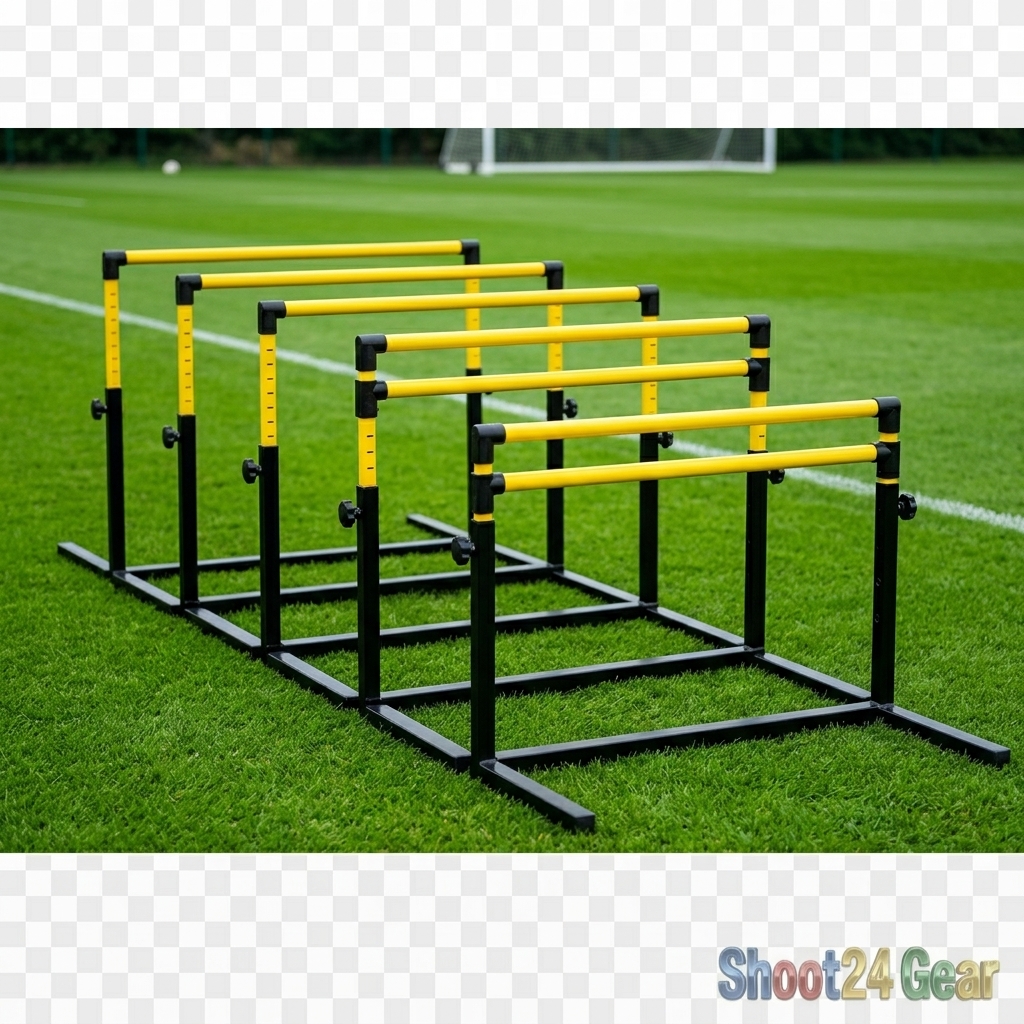
Adjustable hurdles allow height modification between approximately fifteen and forty-five centimeters, providing variable plyometric challenge from a single piece of equipment. The significant height adjustability eliminates the need to purchase multiple separate hurdle sets at different fixed heights, providing highly cost-effective versatility for coaches working with athletes at different developmental levels or programming sessions that progress through increasing heights within a single training block.
Foam Hurdles
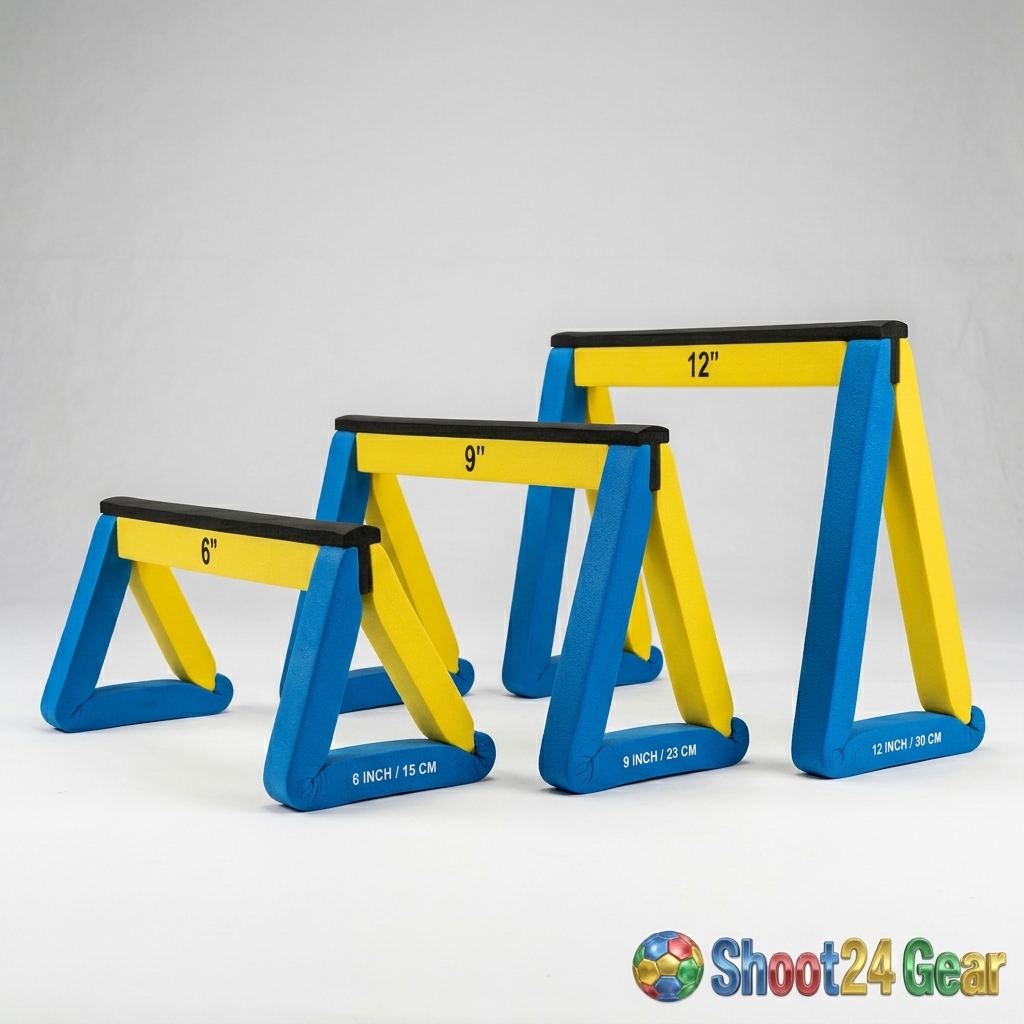
Foam hurdles use soft foam construction that presents zero injury risk from contact. These hurdles suit youth training environments where safety is the primary equipment consideration and young athletes are developing the coordination and jump timing that more advanced plyometric training requires. Foam hurdles compress completely and harmlessly on contact, providing essential psychological confidence for young or novice athletes who may hesitate during jumping exercises due to fear of hurdle contact and the associated impact.
Height Selection
Low hurdles (15-20cm): Suitable for speed-focused plyometric drills where rapid ground contact time is the primary objective rather than jump height. Low hurdle drills develop fast-twitch muscle fiber recruitment and reactive ground contact patterns that transfer to acceleration mechanics and rapid directional changes during match play movement patterns.
Medium hurdles (25-35cm): The most versatile height range for football plyometric training. Medium hurdles challenge explosive power production while maintaining the rapid movement tempo that football-specific conditioning requires. This versatile height range suits the majority of plyometric drill programming for adult and advanced youth footballers across all positional requirements and training objectives throughout the competitive season.
High hurdles (40-50cm): Maximum plyometric challenge that develops peak explosive power through demanding jump heights. High hurdles require significant lower-body power and are appropriate only for experienced athletes with well-established plyometric training foundations who can maintain proper landing mechanics at these heights. Use high hurdles selectively within training programs rather than as standard plyometric prescription.
Football-Specific Drills
Continuous bilateral jumps: Sequential two-footed jumps over a line of hurdles develop the reactive power used in jumping challenges, recovery landing, and rapid vertical displacement during match play. Focus on minimizing ground contact time between hurdles while maintaining consistent jump height across all repetitions in the sequence.
Single-leg hops: Hopping over hurdles on a single leg develops unilateral explosive power and landing stability that directly transfers to the single-leg ground contacts that occur during running, cutting, and kicking actions in football. Alternate consistently between left and right legs across sets to develop balanced bilateral power output that prevents strength asymmetries from developing.
Lateral hurdle jumps: Jumping laterally over hurdles develops the explosive lateral movement power used in defensive shuffling, lateral positioning adjustments, and side-to-side agility that multiple football positions demand. Lateral plyometric development is too often neglected in favor of purely forward movement training, making lateral hurdle drills particularly valuable for comprehensive explosive power development.
Hurdle-to-sprint transitions: Completing a hurdle plyometric sequence then immediately sprinting a designated distance (ten to twenty meters) develops the transition from explosive jumping to maximum-speed running. This combination replicates match situations where players must jump, land, and immediately accelerate — heading duels followed by sprinting to the second ball, for example.
Multi-directional combinations: Combining forward jumps, lateral jumps, and backward jumps over hurdle arrangements develops the multi-directional explosive capability that football requires. These complex combinations challenge both physical explosive power and cognitive processing of movement sequences, developing the coordinated and adaptable athleticism that clearly distinguishes high-level footballers from their less physically prepared peers in competitive match situations.
Technique Fundamentals
Landing mechanics: Land softly on the balls of the feet with knees tracking over the toes and hips absorbing landing forces through controlled flexion. Avoid stiff-legged landing that transmits impact forces directly through the knee and hip joints, increasing injury risk. Proper landing mechanics are the most important safety and effectiveness consideration in plyometric training — never compromise landing quality for jump height or speed.
Arm action: Drive arms vigorously upward during take-off to contribute to jump height and forward momentum. Arms provide approximately ten to fifteen percent of total vertical jump impulse — neglecting active arm drive during hurdle jumps significantly reduces jump height and makes clearing hurdles unnecessarily difficult.
Core stability: Maintain stable trunk position throughout the jump-land-jump cycle. Core instability during plyometric exercises wastes energy through unnecessary trunk movement and reduces the efficiency of force transfer from landing to the subsequent jump. Strong core engagement throughout the plyometric sequence enables faster, more powerful ground contacts.
Progression Guidelines
Foundation phase (weeks 1-3): Begin with low hurdles, bilateral jumps only, and four to six hurdles per sequence. Focus exclusively on proper landing mechanics and developing consistent, safe jump technique patterns. Perform three to four sets of each exercise with two to three minutes recovery between sets.
Development phase (weeks 4-6): Increase to medium hurdle heights, introduce single-leg exercises alongside bilateral jumps, and extend sequences to six to eight hurdles. Reduce recovery time slightly (ninety seconds to two minutes) as the neuromuscular system adapts to plyometric demands.
Advanced phase (weeks 7+): Include high hurdles selectively, introduce multi-directional combinations, add hurdle-to-sprint transitions, and increase volume modestly. At this stage, plyometric training should integrate with speed work using speed parachutes, agility ladder exercises, and football-specific conditioning for comprehensive and well-rounded athletic development for competitive football performance.
Safety Considerations
Surface requirements: Perform hurdle plyometric training on surfaces that provide adequate shock absorption — natural grass, quality artificial turf, or gymnastics matting. Hard surfaces (concrete, tarmac, indoor hard courts) increase impact forces on joints and should be avoided for high-volume plyometric training. The impact forces during plyometric landing are three to five times body weight, making surface selection a critical safety consideration.
Fatigue management: Plyometric quality deteriorates rapidly with fatigue — tired athletes produce lower jumps with compromised landing mechanics that increase injury risk. End plyometric sets when landing quality visibly deteriorates rather than pushing through fatigue to complete a predetermined repetition count. Quality always takes absolute priority over quantity in all plyometric training programming and execution.
Volume management: Total plyometric ground contacts per session should be managed to prevent overloading the musculoskeletal system. Beginning athletes should accumulate sixty to eighty ground contacts per session, intermediate athletes one hundred to one hundred twenty, and advanced athletes up to one hundred fifty. Exceeding appropriate volume increases cumulative impact stress beyond the body’s recovery and adaptation capacity.
Budget and Purchasing
Starter set: Six adjustable-height hurdles provide the minimum equipment for effective plyometric drill programming. Adjustable hurdles offer the most versatility within a single purchase, accommodating different training objectives and progression stages without additional equipment investment.
Team set: Twelve to eighteen hurdles enable multiple athletes to work simultaneously during team training sessions. For team purchases, standardizing on a single adjustable hurdle model ensures consistent height settings and drill configuration across all training stations.
Quality considerations: Select hurdles with stable base design that prevents toppling in light wind, reliable height adjustment mechanisms that maintain settings during use, and durable construction that withstands repeated contact from athletes who occasionally misjudge jumps. Avoid the cheapest available hurdles that use thin and weak plastic construction materials prone to cracking and structural failure after only minimal contact from athletes during regular training use.
Age Group Guidelines
Under-10s: Foam hurdles at minimum heights (ten to fifteen centimeters) introduce basic jumping and landing patterns in a completely safe environment. Focus on fun, game-based activities that develop natural jumping coordination rather than structured plyometric programming. At this developmental stage, jumping activities should emphasize enjoyment and movement competence rather than physical performance outcomes.
Under-14s: Collapsible plastic hurdles at low to medium heights (fifteen to twenty-five centimeters) enable progressive plyometric introduction with appropriate safety features. Emphasize landing technique and bilateral exercises before introducing single-leg or multi-directional variations. Plyometric volume should remain conservative — forty to sixty ground contacts per session — as developing bodies are more susceptible to overuse injuries from excessive impact loading than mature athletes.
Under-18s and adults: Full height range and exercise complexity become appropriate as physical maturity and training experience develop. Progressive loading through height increases, volume progression, and exercise complexity enables continued explosive power development throughout the competitive career. Monitor training load carefully during periods of rapid adolescent growth when musculoskeletal vulnerability to plyometric stress is temporarily increased.
Warm-Up Integration
Low hurdle exercises serve effectively as dynamic warm-up components that prepare the neuromuscular system for the explosive demands of the main training session. Progressive hurdle warm-up sequences — starting with walking steps over low hurdles, progressing to jogging two-foot hops, then building to dynamic bilateral jumps — activate the stretch-shortening cycle and prepare joints, tendons, and muscles for the higher-intensity activities that follow in the main session.
Using hurdles as warm-up tools provides dual benefit — neuromuscular preparation for the session and accumulated plyometric training volume that contributes to long-term explosive power development without requiring dedicated plyometric training blocks that compete with football-specific session time. This highly efficient integration strategy maximizes overall training efficiency by seamlessly embedding plyometric development within existing warm-up time that would otherwise serve only a preparatory function.
Common Training Mistakes
Excessive volume: Performing too many plyometric ground contacts per session — particularly early in a training program — creates cumulative impact stress that exceeds the musculoskeletal system’s recovery capacity. Overloading plyometric volume is the most common mistake in hurdle training and the primary and most preventable cause of plyometric-related overuse injuries in football training. Start conservatively with minimal volume and increase gradually based on careful observation of the individual athlete’s physical response and measured recovery capacity.
Poor landing mechanics: Allowing knees to collapse inward during landing, landing flat-footed rather than on the balls of the feet, or using stiff-legged landing that transmits impact forces directly through joints without muscular absorption all increase injury risk significantly. Correct landing technique should be the first priority of any hurdle training program and should be continually reinforced throughout training progression.
Training on hard surfaces: Performing plyometric exercises on concrete, asphalt, or hard indoor surfaces multiplies impact forces beyond safe levels for regular training. Always use shock-absorbing surfaces — grass, quality artificial turf, or athletic flooring with appropriate cushioning — for plyometric hurdle training sessions.
Insufficient recovery: Plyometric training requires neural recovery between sessions. Schedule at least forty-eight hours between plyometric sessions to allow the neuromuscular system to recover and adapt. Performing intensive plyometric training on consecutive days degrades quality and increases injury risk without proportional adaptation benefit.
Maintenance and Storage
Inspection: Check hurdle height adjustment mechanisms, base stability, and structural integrity before each training session. Cracked or weakened hurdles that do not collapse properly on contact create injury risk that intact collapsible hurdles are specifically designed to eliminate. Replace any hurdle showing structural damage immediately.
Storage: Stack or nest hurdles for compact storage. Most collapsible hurdle designs enable stacking that minimizes storage space requirements. Store in dry, sheltered locations that protect plastic components from prolonged UV exposure, which degrades plastic flexibility and structural integrity over time.
Transport: Hurdle sets require organized transport solutions — dedicated equipment bags or carrying systems — that protect hurdles during transit and simplify setup and pack-down at training locations. Well-organized transport systems effectively prevent individual hurdle loss and the equipment damage that frequently occurs when hurdles are loosely transported alongside other training equipment.
Goalkeeper-Specific Applications
Training hurdles provide particularly valuable plyometric training for goalkeepers, whose unique positional demands include explosive diving, rapid lateral movement, and reactive jumping — all of which benefit directly and measurably from targeted plyometric power development using training hurdles.
Lateral hurdle jumps develop the explosive sideways displacement that underpins diving saves. Forward-backward hurdle sequences develop the reactive footwork used in narrowing angles and recovering position. Multi-directional hurdle combinations that finish with a diving or catching action integrate plyometric development with goalkeeper-specific skill execution for maximum training transfer to competitive match-play goalkeeper performance.
Summary
Training hurdles provide structured plyometric training that develops the explosive lower-body power, reactive strength, and multi-directional agility that football performance demands. Select appropriate hurdle heights for your training level and objectives, consistently prioritize landing mechanics and technique quality over jump height and speed at every training stage, and progress systematically through increasing difficulty levels as neuromuscular adaptation develops and is confirmed through reliable performance assessment.
Integrate hurdle plyometric training within carefully structured comprehensive physical development programs that combine explosive power work with sprint training, agility development, and football-specific conditioning for maximum transfer to measurable match-play performance improvement across all playing positions and competitive levels throughout the entire season.