Agility ladders are one of the most widely used footwork training tools in football, providing a structured framework for developing the rapid, precise foot placement that underpins effective movement on the pitch. From grassroots youth sessions through professional club training grounds, the agility ladder appears consistently because it addresses fundamental movement qualities — coordination, foot speed, balance, and neuromuscular control — that contribute directly to football performance in every playing position and at every competitive level.
This comprehensive guide examines agility ladder types, construction quality differences, the most effective football-specific ladder drills, proper technique for maximizing training benefit, common mistakes that reduce ladder training effectiveness, and practical purchasing guidance for coaches and individual players building their training equipment inventory for football-specific footwork development.
Types of Agility Ladders
Flat Rung Ladders
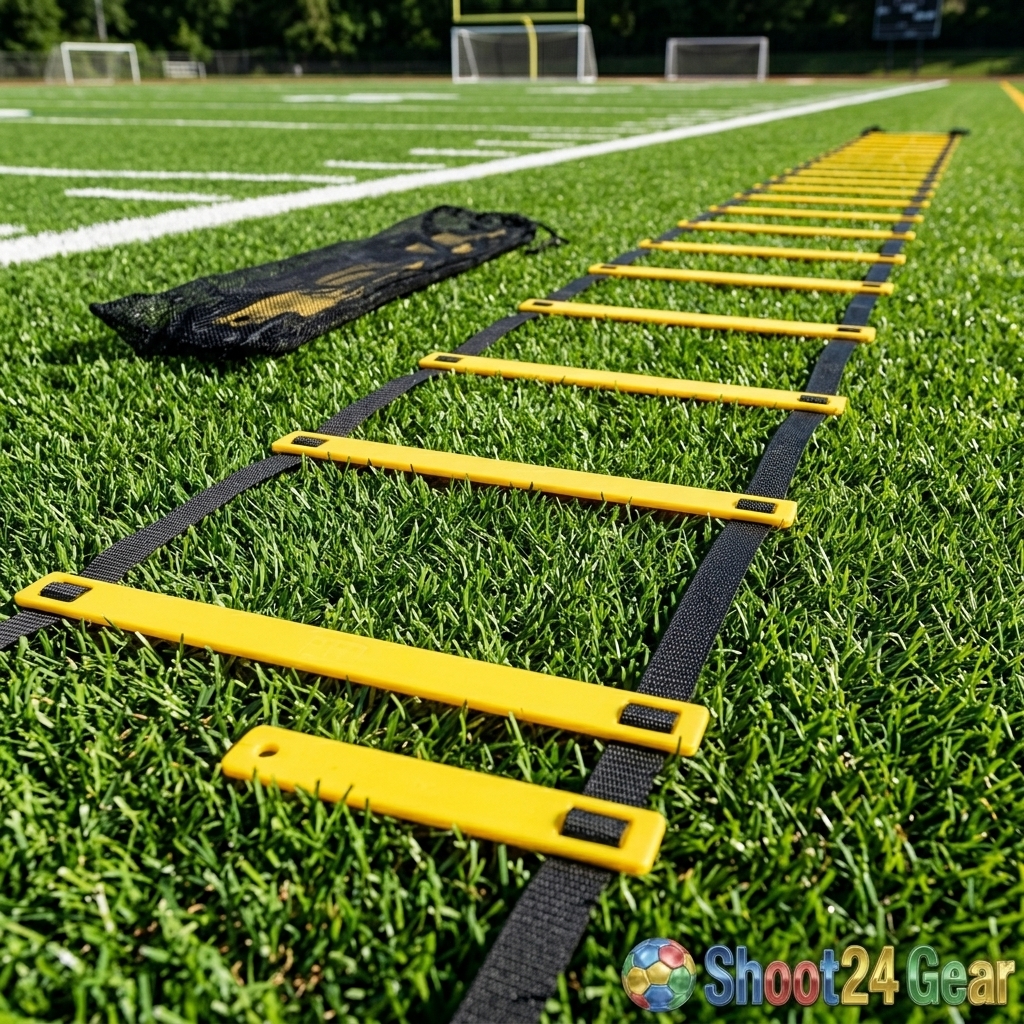
Flat rung ladders are the most common type, using flat plastic or fabric rungs connected by nylon straps. The rungs lie flat on the ground surface, creating minimal trip hazard while providing clear visual reference for foot placement. Flat rung ladders are suitable for all surfaces — natural grass, artificial turf, indoor courts, and hard outdoor surfaces — and roll up compactly for easy storage and transport in training equipment bags.
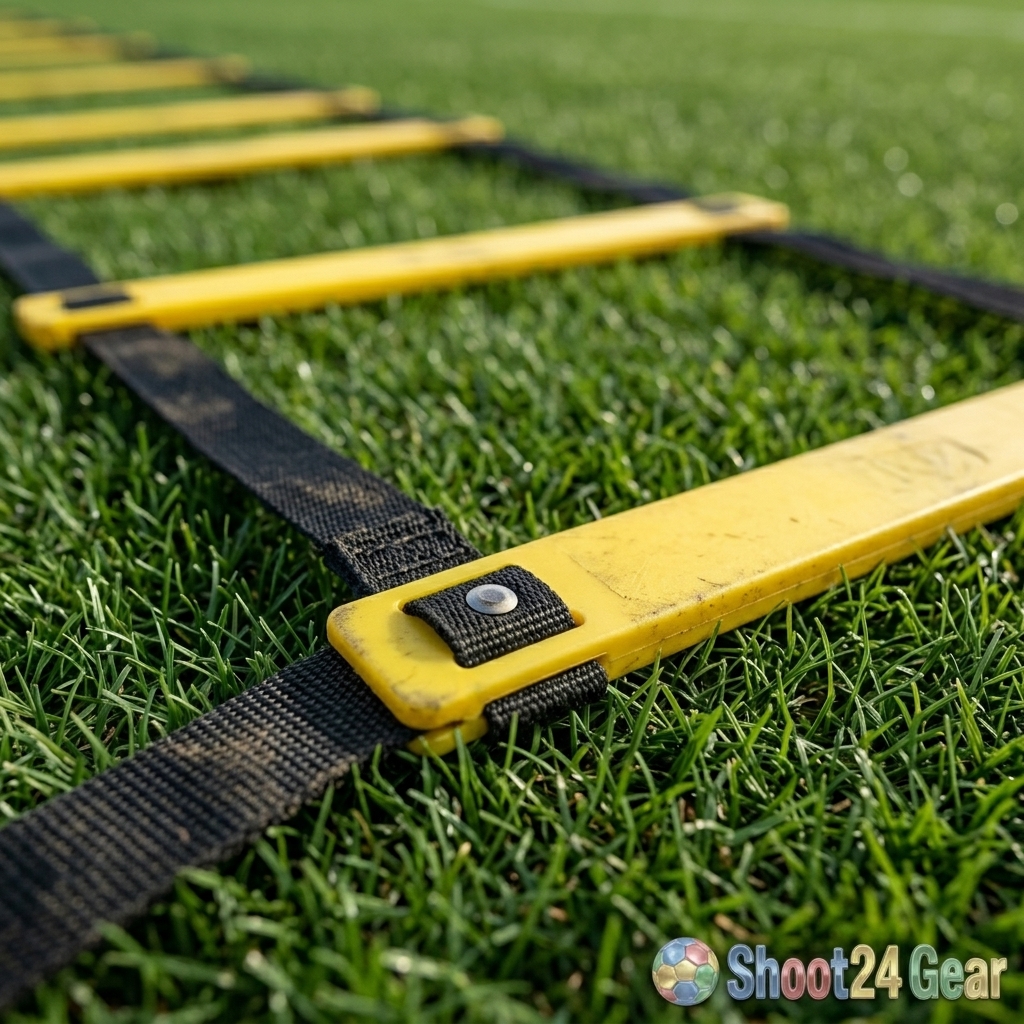
Quality flat rung ladders use rungs that stay in position during use rather than sliding along the connecting straps and bunching together. Look for ladders with fixed-position rungs that maintain consistent spacing throughout the drill, or adjustable rung systems that lock into position once set. Ladders with freely sliding rungs require constant readjustment during training, wasting valuable session time and disrupting drill flow.
Raised Rung Ladders
Raised rung ladders position the rungs several centimeters above the ground surface, requiring players to lift their feet higher during ladder exercises. This elevated foot clearance demand increases the coordination and hip flexor engagement required for each step, adding a strength component to the coordination training that flat ladders provide. Raised rung ladders are progression tools for players who have mastered flat ladder exercises and need increased difficulty to continue developing.
Speed Ladders
Speed ladders use narrower rung spacing — typically thirty centimeters compared to the standard forty to forty-five centimeter spacing — to demand faster foot turnover rates. The reduced spacing compresses the movement pattern, requiring quicker ground contact times and faster neuromuscular processing. Speed ladders are specialist tools for developing maximum foot speed rather than general coordination and should supplement rather than replace standard-spacing ladder training.
Football-Specific Ladder Drills
Single-foot linear run: The foundational ladder drill — running through the ladder placing one foot in each rung while maintaining forward momentum. This drill develops basic foot speed and coordination and serves as the warm-up progression before more complex patterns. Focus on landing on the balls of the feet with minimal ground contact time rather than flat-footed running through the rungs.
Two-foot linear run: Both feet touch inside each rung before advancing to the next. This drill develops the rapid double-step patterns used in football for quick directional adjustments and close-control dribbling footwork. Maintain low center of gravity and quick arm drive to support rapid foot turnover.
Lateral shuffle: Moving sideways through the ladder with both feet touching each rung develops the lateral movement patterns essential for defensive positioning, jockeying, and lateral tracking of opponents. This drill directly replicates the sideways shuffling that defenders use throughout matches and training sessions.
In-out drill: Alternating between stepping inside and outside the ladder rungs develops the rapid directional change footwork used in one-versus-one situations, dribbling past opponents, and creating separation from markers. The inside-outside stepping pattern mirrors the footwork used for stepovers and body feints in match situations.
Icky shuffle: A three-step pattern (in-in-out) that progresses laterally through the ladder, developing the complex footwork coordination that enables rapid directional changes during match play. This drill is particularly valuable for attacking players who need multi-directional agility for beating defenders in tight spaces.
Proper Technique
Ladder training effectiveness depends heavily on movement quality rather than simply completing patterns quickly. Poor technique during ladder drills creates movement habits that may hinder rather than help football performance.
Foot placement: Land on the balls of the feet with toes pointing forward. Avoid heel strikes that slow ground contact and flat-footed landing that reduces elastic energy return. The ball-of-foot landing position replicates the ready position used in football for rapid directional changes and acceleration.
Arm action: Drive arms actively in opposition to leg movement — the same arm coordination used in sprinting and rapid running. Arms provide balance and rotational counter-force that enables faster, more controlled foot movement. Players who let their arms hang passively during ladder drills develop slower movement patterns than those who maintain active arm drive throughout.
Body position: Maintain a slight forward lean with eyes focused ahead rather than down at the ladder rungs. Looking down at the feet creates a head-down body position that contradicts the head-up awareness that football requires during match play. Developing the ability to execute precise footwork without visual foot monitoring translates directly to maintaining spatial awareness while performing complex movements during matches.
Quality over speed: Execute patterns with precise foot placement before progressively increasing speed. Rushing ladder drills with sloppy technique develops fast but imprecise movement patterns. Build accuracy first, then add speed progressively as the neuromuscular patterns become automatic and reliable.
Benefits for Football
Neuromuscular coordination: Ladder drills develop the neural pathways that control rapid, precise foot placement — the same neural pathways that execute close ball control, quick turns, and reactive positional adjustments during match play. This neuromuscular development is the primary and most valuable benefit of ladder training for footballers.
Warm-up activation: Ladder exercises serve as effective neuromuscular warm-up activities that prepare the nervous system for the rapid, complex movements that football training demands. Progressive ladder drill sequences — from simple to complex patterns — provide structured warm-up progressions that activate coordination systems before the main training session.
Injury prevention: The controlled, precise foot placement that ladder training develops contributes to ankle stability, knee tracking, and proprioceptive awareness that reduces lower-limb injury risk during the uncontrolled, reactive movements that football involves. Players with better neuromuscular control are less likely to suffer the ankle sprains and knee injuries that result from imprecise foot placement during rapid directional changes.
Common Mistakes
Excessive ladder focus: Some coaches and players devote disproportionate training time to ladder work. Ladder drills develop specific neuromuscular qualities but do not replace football-specific training — dribbling practice, game play, and sport-specific conditioning. Ladder training should occupy five to fifteen minutes of a training session, typically during warm-up or as a circuit station, not serve as a primary training activity.
Looking down at feet: Staring at the ladder and feet during drills is the most common technique error. While understandable during initial learning, habitual downward focus should be progressively eliminated as patterns become familiar. Use peripheral vision to guide foot placement while maintaining forward or upward gaze.
Neglecting quality for speed: Players rushing through ladder patterns with imprecise foot placement and sloppy technique derive less benefit than players executing patterns precisely at moderate speed. Speed without accuracy is counterproductive — it reinforces imprecise movement patterns that do not transfer to football performance improvement.
Using only one drill pattern: Repeating the same ladder drill pattern every session provides diminishing returns as the nervous system adapts. Vary drill patterns regularly to continue challenging neuromuscular coordination and prevent adaptation plateaus.
Selection Criteria
Length: Standard agility ladders are four to six meters long with eight to twelve rungs. This length provides adequate drill distance for effective footwork training. Longer ladders (eight to ten meters) suit team training where multiple players work through the ladder in sequence, but shorter ladders are adequate for individual and small-group use.
Rung spacing: Standard forty to forty-five centimeter rung spacing suits most adult footballers. Youth players below age twelve may benefit from narrower spacing that matches their stride length. Some ladders offer adjustable rung spacing that accommodates different drill types and user sizes from a single piece of equipment.
Rung construction: Rigid plastic rungs maintain shape and positioning better than soft fabric rungs. The rigidity provides clearer visual reference and more consistent spacing during use. However, rigid rungs present slightly higher trip risk than soft rungs that compress under foot contact.
Portability: The ladder should roll or fold compactly enough to fit in a standard training equipment bag alongside training cones and other session equipment. Avoid ladders that require excessive storage space or complex folding procedures that discourage regular transport and use.
Integration into Training Sessions
Effective ladder training integration positions ladder work within the overall session structure where it provides maximum benefit without displacing more football-specific training activities.
Warm-up phase: Progressive ladder drill sequences during warm-up activate neuromuscular systems and prepare the body for the complex movements that follow. Start with simple linear patterns and progress to more complex multi-directional drills as the warm-up advances.
Circuit stations: Ladder drills as one station within a multi-station training circuit combine footwork development with other physical qualities — speed development, strength work, and plyometric training — in a time-efficient format that addresses multiple development objectives within a single training block.
Progression Programming
Effective ladder training follows a progressive structure that builds complexity and speed over time as neuromuscular patterns develop and become automatic.
Week 1-2 (Foundation): Focus on two to three basic patterns — single-foot linear, two-foot linear, and basic lateral shuffle — at moderate speed with emphasis on precise foot placement and correct body position. Allow players to look at the ladder as needed during this learning phase. Perform each pattern three to four times with adequate rest between repetitions.
Week 3-4 (Development): Add in-out patterns and icky shuffle while increasing speed on foundation patterns. Begin encouraging head-up gaze during familiar patterns while allowing visual guidance for new patterns. Reduce rest periods between repetitions to increase cardiovascular component alongside coordination development.
Week 5-6 (Integration): Combine ladder patterns with football-specific actions — completing a ladder pattern then immediately receiving a pass, executing a ladder drill then sprinting to a cone for a directional change. This integration phase connects ladder-developed footwork to football match scenarios, improving the transfer of training benefit to performance.
Week 7+ (Advanced): Introduce dual-ladder configurations, combine ladder patterns with cognitive tasks (calling colors, counting, decision-making cues), and add ball manipulation during ladder exercises for the most advanced progression. These complex combinations challenge both physical coordination and cognitive processing simultaneously, developing the multitasking capacity that football demands during match play.
Surface Considerations
Natural grass: The most common ladder training surface. Ladder rungs sit flat on grass with minimal sliding. In wet conditions, nylon strap connectors may become slippery underfoot — caution players about maintaining precise foot placement when ladder edges are wet. The natural grass surface provides moderate cushioning that reduces joint stress during high-repetition footwork exercises compared to harder surfaces.
Artificial turf: Ladders grip well on artificial turf surfaces. The consistent flat surface of artificial turf provides ideal conditions for precise foot placement training. However, the firmer surface increases impact forces on joints compared to natural grass — limit ladder drill volume on artificial turf for players with joint sensitivity or recovering from lower limb injury.
Indoor surfaces: Ladder training on indoor gym floors or sports hall surfaces requires ladders with rubberized or textured rungs that grip the floor without sliding. Standard nylon-strap ladders may slide on polished indoor surfaces, creating inconsistent rung spacing and potential slip hazards. Verify ladder stability on your indoor surface before using it for high-speed drills with players.
Age Group Adaptations
Under-8s: Use simple two to three step patterns with wider rung spacing. Focus on fun, game-based ladder activities rather than repetitive technical drills. At this age, the primary objective is developing basic coordination and movement enjoyment rather than football-specific footwork patterns. Shorten drill duration and increase variety to maintain engagement.
Under-12s: Standard ladder drills with full rung spacing become appropriate as coordination and limb length develop. This age group can learn four to six different ladder patterns and begin developing the speed emphasis alongside accuracy. Introduce basic combination drills that connect ladder work to ball activities, building the movement foundation for technical development in subsequent years.
Under-16s and adults: Full drill complexity, maximum speed progression, and integrated football-action combinations are appropriate for this developmental stage. Players at this level should be challenged with complex multi-directional patterns, cognitive dual-tasks during ladder execution, and competitive timed ladder challenges that develop both coordination and competitive intensity during footwork training.
Maintenance and Storage
Agility ladders require minimal maintenance but benefit from basic care that extends their usable lifespan and maintains consistent training quality across seasons of regular use.
Cleaning: Rinse ladders with water after training on muddy surfaces. Allow complete drying before storage to prevent mold growth on fabric straps and nylon connectors. Mud accumulation on rungs adds unnecessary weight and can obscure the visual reference that clear rung edges provide during footwork drills.
Storage: Roll or fold ladders loosely rather than cramming them into tight spaces that deform rung shapes and stress connecting straps. Store in dry locations protected from direct sunlight that degrades nylon strap material over extended exposure periods. A dedicated storage hook or shelf maintains ladder condition better than floor-level storage where equipment stacking causes deformation.
Inspection: Check rung attachment points and connecting straps periodically for wear, fraying, or damage that could cause rung detachment during use. Replace ladders when rungs become loose, connecting straps show significant fraying, or rung material cracks and creates potential sharp edges that could contact players’ feet during training.
Budget and Purchasing
Individual use: A single quality agility ladder of four to six meter length with fixed or adjustable rung spacing provides adequate equipment for individual footwork development. Individual ladders represent a modest investment that delivers significant training capability for self-directed footwork improvement between organized team training sessions.
Team use: Teams benefit from multiple ladders — typically three to four for a full squad — enabling multiple players to work simultaneously during warm-up and circuit training without excessive queuing that reduces active training time. Multiple ladders also enable parallel configuration (ladders side-by-side for competitive paired drills) and sequential configuration (end-to-end for extended footwork sequences).
Quality indicators: Avoid the cheapest available ladders that use thin straps, lightweight rungs, and no rung-fixing mechanism. These economy ladders require constant rung readjustment and typically last less than one season of regular training use. Mid-range ladders from recognized training equipment brands provide the optimal balance of durability, functionality, and value for both individual and team training use.
Summary
Agility ladders provide valuable football-specific footwork development when used correctly — with proper technique emphasis, appropriate session time allocation, and progressive drill variety that continues challenging neuromuscular coordination as players develop. Select quality ladders with fixed or adjustable rung spacing and rigid rung construction for consistent, effective training delivery.
Position ladder training within warm-up phases or circuit stations rather than as standalone primary training. Focus on movement quality before speed progression, and maintain head-up body position that transfers to match-play awareness. Combined with complementary training equipment and football-specific practice, ladder training contributes meaningfully to the footwork foundation that supports technical skill execution in match situations.